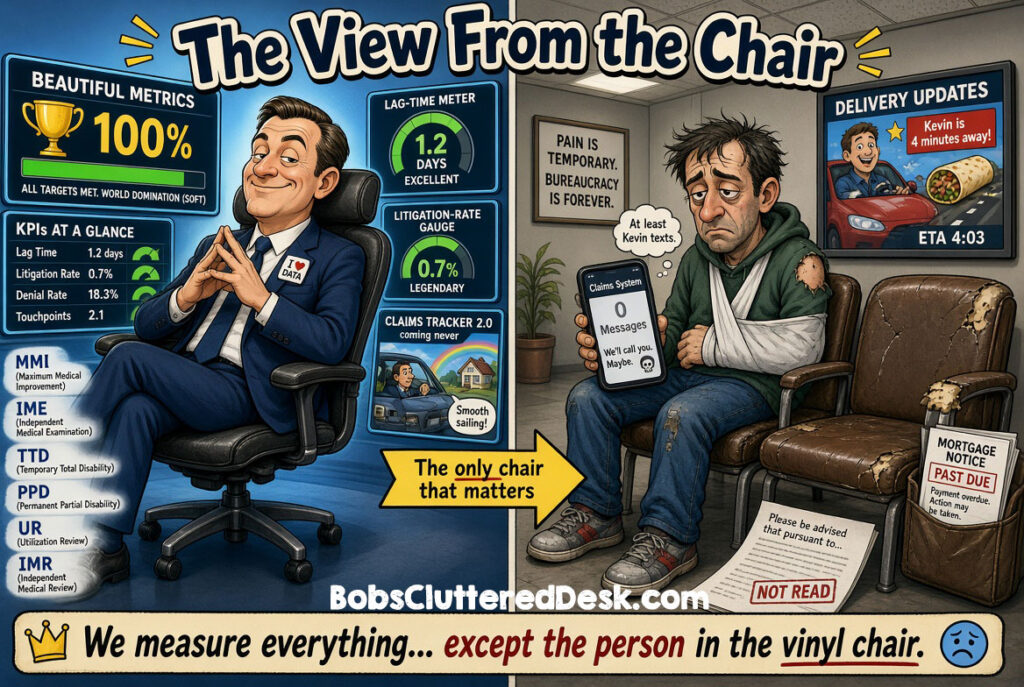
We measure everything in this industry.
We measure lag time, closure ratios, average duration, medical spend per claim, litigation rates, attorney involvement, reserve accuracy, and the number of days between the injury and the first indemnity payment. We have dashboards. We have benchmarking studies. We have entire conference tracks devoted to measuring things, and then a networking reception afterward where we talk about what we measured.
Every one of those numbers is taken from our chair.
There is another chair. It is usually vinyl, it is usually in a waiting room, and the person in it has a shoulder that no longer works and a mortgage payment due on the first. Nobody benchmarks that chair. There is no dashboard for it. And it is the only chair in the entire system where the actual product of workers’ compensation gets delivered.
So let us sit in it for a few minutes.
You got hurt on a Tuesday. You told your supervisor, who said he would “take care of it,” which turned out to mean he told somebody else, who was at lunch.
You went to a clinic where a person you have never met asked you to explain the accident four separate times to four separate people, each of whom typed while you talked and none of whom looked up. You signed nine pages. You read none of them, partly because of the pain medication and partly because nobody reads nine pages.
Then you went home and waited.
That is the part we do not measure. The waiting. Somewhere in a building a file was opened, a diary was set, a form was transmitted to the state, and by every internal metric we were performing beautifully. From the vinyl chair, nothing happened at all. For six days, the sum total of the workers’ compensation system’s communication with the injured human being at its center was a letter that began “Please be advised that pursuant to.”
Meanwhile that same person can open an app and learn that Kevin is four minutes away with a burrito. He can watch Kevin’s little car icon turn left. Kevin will text if there is a delay. Kevin, who is delivering a burrito, has a communication protocol more responsive than the one attached to a herniated disc.
I am not suggesting we need a claims tracker with a tiny animated adjuster driving toward your house. Although I have thought about it, and I would look at that dashboard.
Here is the thing that surprised me most in the decade I spent working on my book. When you ask injured workers what made their experience a good one, almost nobody talks about the money. They talk about how they were treated. The list is remarkably consistent, remarkably human, and remarkably cheap.
Somebody called, fast, and that somebody was sorry. Not “I am calling to obtain a recorded statement.” Just a human voice within a day saying this happened, that stinks, I am the person who is going to help you, here is my direct number. The recorded statement can wait a week. Nobody has ever recovered faster because we got the statement on Thursday instead of the following Tuesday.
They believed me. This is the big one, and it is the one we are structurally worst at. We built an entire posture around the small percentage of claims that are fraudulent and then applied it to everyone, which is a bit like greeting every customer at the door with a metal detector and then wondering why they seem tense. The injured worker can feel suspicion. They can hear it in the questions. And nothing radicalizes a reasonable person faster than being treated like a liar about something that actually happened to them.
They told me what would happen next, and then it happened. Not a promise of a good outcome. Just a sequence. You will hear from the doctor’s office by Friday, I will call you Monday either way, the first check should arrive the following week. Certainty is medicine. Uncertainty is the thing that keeps people awake at two in the morning building elaborate theories about what we are up to.
I had one name and one number. Not a queue. Not a general mailbox. Not a claim number that gradually replaced my actual name in every piece of correspondence I received.
They spoke English. Actual English. Not MMI, IME, TTD, PPD, UR, and IMR delivered in a rapid burst to a person with a ninth grade reading level, a concussion, and no earthly reason to know what any of that means. Somewhere out there is a worker who spent three weeks believing MMI was a diagnosis.
The money came when they said it would. Financial panic is not a side issue that runs parallel to the medical claim. It is part of the medical claim. A person worried about the electric bill heals slower than a person who is not, and there is a growing pile of research saying exactly that. On-time indemnity is clinical care that happens to be paid out of a different bucket.
My employer called me. About me. Not about the paperwork, not about when I am coming back, not about whether I remembered to drop off the form. Just called. The number of injured workers whose lasting bitterness traces back to a simple and total silence from the place they gave fifteen years to is genuinely staggering. It costs a phone call. We spend more than that on the pens.
By the way, if you are an employer, go back and read that last part again. It will be worth your time.
Somebody told me I was going to get better. Early, out loud, and with conviction. Expectation of recovery is one of the strongest predictors of actual recovery in the literature, and we routinely say nothing at all, which the person in the vinyl chair reasonably interprets as bad news we are too polite to share.
Somebody asked me what I thought. Not told. Asked. About the job I could do, about what hurts, about what I am worried about. People who feel like participants in their recovery do better than people who feel like cargo.
The Uncomfortable Math
Read that list again and notice what is on it.
A phone call. Some plain language. A schedule that gets honored. An expression of sympathy that costs nothing and takes eleven seconds. Not one item on that list requires legislative reform, a rate filing, a new platform, or a task force, which regular readers will recognize as my four favorite ways of not solving something.
Now price out the alternative. Price out the attorney, the litigated file, the additional eighteen months, the surgery that might have been avoided, the worker who never returns to the labor force at all. We will spend eighty thousand dollars fighting about a claim rather than spend forty minutes preventing the fight.
This is the argument at the center of Thank You For Holding, and it is why the title is what it is. “Your call is important to us” is the precise sound the system makes while it is doing nothing. Thirteen chapters and roughly one hundred jokes later, the conclusion is embarrassingly simple. We are extremely good at managing claims. We were never asked to manage claims. We were asked to help hurt people get better and get back to living, and somewhere in the last century we quietly swapped the second job for the first because the first one is easier to put on a dashboard.
One last thing about the chair: The people who do this well are already among us. I meet them constantly. They are the adjusters who call on day one, the nurses who explain things twice without making anyone feel stupid, the employers who send somebody to the hospital and then keep showing up. They are not following a special protocol. They are mostly just behaving the way a decent person behaves toward someone having a rotten month.
That is the whole secret. It is not a technology problem, and it is not a compliance problem.
It is a chair problem. We have simply been sitting in the wrong one.
Excellent article, Bob! I have sent to my leaders to read it as well. As leaders we tend to manage by metrics and report key measurements that demonstrate the value of our services. While producing meaningful outcomes is necessary in this world, it’s not why we do this. Our nurses make a difference to someone hurt, and scared about their future of work, their quality of life. And if that injured worker doesn’t speak English, the fear and complexity is magnified. I appreciate the very clear reminder to sit in that vinyl chair each day.
Copilot said:
This article really resonated with me. In a world driven by technology, automation, and metrics, the human touch is more important than ever. Behind every claim and every dashboard is a person facing pain, uncertainty, and stress.
Technology helps us work more efficiently, but it can never replace empathy, clear communication, and genuine human connection. Sometimes the most meaningful impact comes from a simple phone call, listening with compassion, and making someone feel heard and supported. Those moments may not show up on a dashboard, but they can make all the difference in a person’s recovery.