Let me begin by disappointing a portion of the audience. This is not that kind of culture war. Nobody here is going to yell about a beer can, a coffee cup, or a cartoon character. If that is what you came for, the exit is on your left, right next to the cable news channels.
The culture warrior I am talking about is a rarer and far more useful creature. This is the person who shows up every day and fights for the way a workplace actually operates. Not the way the poster in the break room says it operates. The way it actually operates, at 4:45 on a Friday afternoon, when something has gone wrong and somebody has to tell the boss.
Here is the thing about corporate culture. Every company has one, in the same way every office refrigerator has a smell. The only question is whether anyone is tending to it, or whether it has been left alone since the Clinton administration to develop into something with its own zip code.
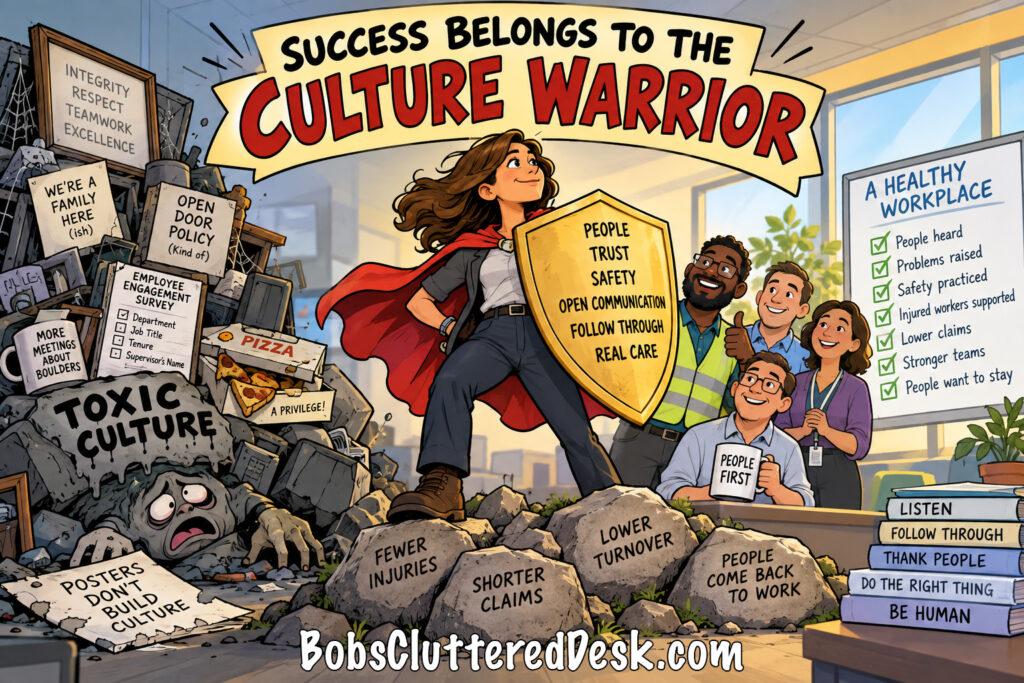
Toxic cultures are remarkably easy to identify, largely because they all bought the same starter kit. The kit includes a set of laminated values (Integrity, Respect, Teamwork, Excellence) suitable for framing in the lobby, typically right above the desk of the person who was just written up for reporting a problem. It includes an Open Door Policy, where the door is open in roughly the same sense that a bear trap is open. It includes an employee engagement survey that is completely anonymous and asks only for your department, your job title, your tenure, and your supervisor’s name.
It also includes the phrase “we’re a family here,” which is accurate, provided your family holds a quarterly review to decide which of the children are no longer aligned with the strategic vision.
And when morale finally collapses, the toxic organization reaches for its most sophisticated management tool. Pizza. Nothing says “we have heard your concerns about chronic understaffing and mandatory overtime” like two slices of lukewarm pepperoni and a memo reminding you that the pizza is a privilege.
I should confess that I am in no position to throw stones. My own desk is so cluttered it could reasonably be classified as a hostile work environment. But even I can see the pattern, and I can barely see my monitor.
Now for the serious part, which I am contractually obligated to include so this qualifies as professional commentary and not just a man complaining.
In workers’ compensation, we do not get to treat culture as a soft topic. We are the industry that receives the invoice. Culture shows up in our world as a claim number.
Consider what happens in a workplace where people do not trust the people they work for. Hazards go unreported, because the last person who reported one was labeled a troublemaker. Minor injuries go unreported too, until they are no longer minor. And when someone is finally hurt badly enough that it cannot be ignored, the first phone call they make is not to their supervisor. It is to the attorney on the billboard, who at least promised to return the call.
We spend enormous energy in this industry wondering why some claims go sideways. We build models. We buy software. We hold conferences about it, in ballrooms, with lanyards, and everything. Meanwhile the answer is often sitting right there in the file. Nobody from the employer ever called the injured worker to ask how they were doing. They called to ask when the worker was coming back, which is a different question, and everyone on the receiving end of it knows the difference.
An injured worker who is treated like a suspect will eventually behave like a defendant. That is not a character flaw. That is a reasonable response to the system in front of them.
The same is true inside our own house. A claims operation that measures its people only on closures and caseload should not be shocked when human beings start getting processed like file numbers. You cannot run your own people through a wood chipper and then expect them to deliver compassion to the public. Culture is not a thing you can hand out to customers while withholding it from employees. It leaks. It always leaks.
The healthy organizations, by contrast, are almost disappointingly boring. There is no secret. There is no ping pong table that fixes it. The leaders do what they said they would do. Bad news travels upward at the same speed as good news. The person who raises a problem gets thanked instead of managed out. Safety is something people do when no one is watching, not a banner counting the days since the last time someone got caught. And when an employee gets hurt, somebody who knows their name picks up the phone and means it.
None of that requires a consultant. Most of it does not even require a budget. It requires someone willing to care about it on the days when caring is inconvenient, which, as it turns out, is most of the days.
That someone is the culture warrior. Sometimes it is the CEO, and when it is, the whole company feels it. More often it is a supervisor, a safety manager, an adjuster, or an HR person who keeps pushing the boulder up the hill while the organization around them schedules another meeting about boulders. They rarely get a plaque. They often get an eye roll. They are also, quietly, the reason their employers have fewer injuries, shorter claims, lower turnover, and people who actually want to come back to work after they have been hurt.
Culture, in the end, is what remains after the poster falls off the wall. Companies that understand this tend to succeed, and they tend to do it without ever ordering an emergency pizza. Companies that do not understand it will continue to be baffled by their results, and will no doubt form a committee to study the matter.
Success belongs to the culture warrior. The rest are just laminating.