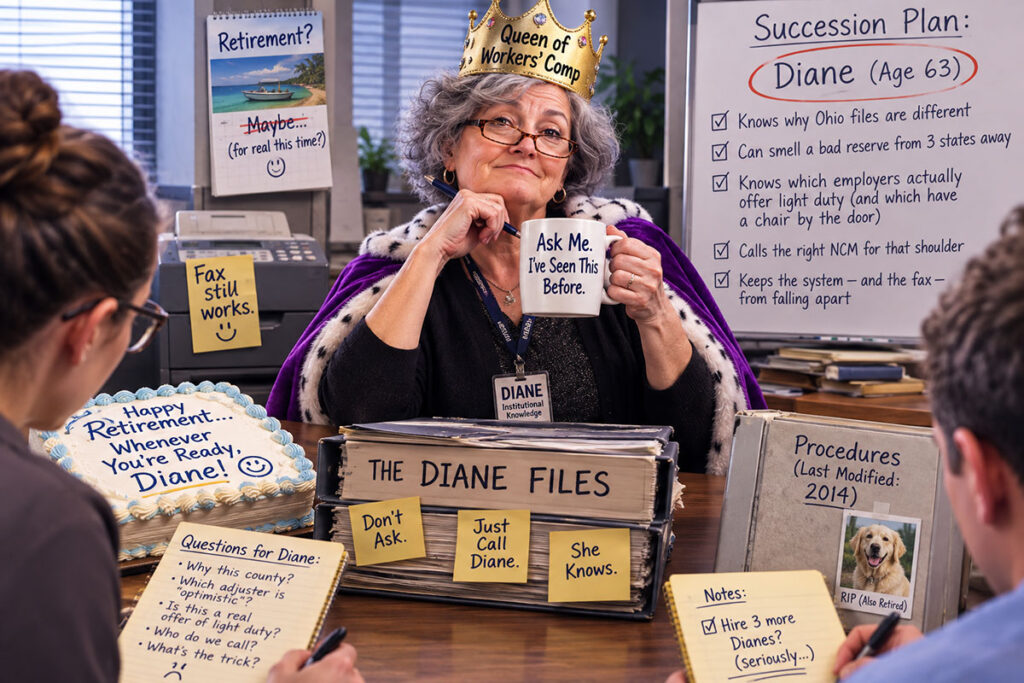
Every organization in workers’ compensation has a succession plan.
I know this because I have asked. Repeatedly. At conferences, on panels, in the hallway outside the ballroom where the coffee is somehow both burnt and cold. And to their credit, people always have an answer for me.
The answer is usually a name.
Somewhere in your organization there is a woman named Diane. She may be named Patti, or Sharon, or Denise, or in rare and notable cases, Gary. But for our purposes today, she is Diane. Diane has been here since before the current claims system, and before the one that preceded it. Diane knows why the Ohio files are handled differently. Diane knows which employer actually means it when they say light duty is available and which one means “we have a chair by the door.” Diane knows the fax number still works because Diane is the reason it still works.
And Diane is sixty-three.
That is your succession plan. Her name is Diane, and she is sixty-three, and everyone in your building has quietly agreed not to think about it.
Now, some organizations have documented their succession strategy, and I want to give credit where it is due. Having reviewed the field, I can report that the following models are currently deployed across our industry:
The Two-Week Overlap. The incoming person shadows Diane for ten business days, four of which Diane spends burning her remaining PTO, and one of which is a mandatory compliance training on a topic neither of them has ever encountered. Thirty-one years of institutional knowledge, transferred at a rate of roughly one anecdote per hour.
The Shared Drive. There is a folder. It is called “Procedures.” It was last modified in 2014. It contains four documents, two of which are the same document, and a photograph of someone’s dog. The dog has also retired.
The Emergency Un-Retirement. Diane leaves. Three weeks later, someone discovers what Diane was doing. Diane returns as a consultant at a rate that would have been cheaper as a raise. Everyone agrees this arrangement is temporary. Diane buys a boat. And pays off her mortgage.
The Flattening. Rather than replace Diane, you distribute her responsibilities across four people who already had full-time jobs. This is presented in the all-hands meeting as an exciting opportunity for cross-functional growth. It is called “flattening the org chart,” which is also an accurate description of what happens to the people in it.
The Software Solution. Surely the platform will know. Surely somewhere in the implementation, the vendor will capture why the venue in that one county requires a different approach entirely. The demo was very impressive. There was a dashboard and everything.
The Faith-Based Model. Diane seems healthy. Diane likes it here. Diane’s husband is not really a hobbies person. This is not written down anywhere, but it is load-bearing.
I want to be clear that I am not making fun of anyone in particular. I am making fun of virtually everyone, which I find to be a more defensible position.
Here is the problem with all of this, and it is the reason I keep circling back to a topic that does not lend itself to punchlines.
We are not losing headcount. We are losing judgment. And it’s called brain-drain.
Process can be documented. Anyone can write down the steps for setting a reserve, filing a form, scheduling an IME. That is the easy part, and it is the part every organization does, because it is checkable and it produces a binder.
What does not go in the binder is why. Why Diane calls that particular nurse case manager for that particular kind of shoulder. Why she reads a certain adjuster’s reserves as reliably optimistic and adjusts accordingly, without ever having said so out loud to anyone. Why she picks up the phone on day three of a claim that looks routine on paper, because something in the injury description does not sit right, and she has been wrong about that feeling maybe four times in three decades.
That is not process. That is pattern recognition built out of thirty years of consequences, most of them somebody else’s. And it walks out the door with a sheet cake and a card that everyone signed but nobody read.
The surveys all say the same thing about our average age, and I do not need to quote them here, because you have seen them and because you can also just look around the room at your next chapter meeting. We built a profession on people who fell into it accidentally in 1994 and then discovered they were good at it and could not leave. That is not a talent pipeline. That is a trap that happened to work, and the trap has stopped catching people.
I am contractually obligated at this point to offer solutions, so here are a few, delivered with the confidence of a man whose own succession plan involves a laptop and a cluttered desk, a place at which he will most likely die of old age.
Document the reasoning, not the steps. Sit Diane down and ask her to talk through the last ten files she had a bad feeling about. Record it. That recording is worth more than your procedures folder and the dog picture combined.
Overlap measured in months, not in Diane’s remaining vacation. Yes, it costs money to have two people in one seat. It costs considerably more to have zero people in it while you figure out what the seat did.
Pay for mentorship. Put it in the job description. Put it in the compensation. Right now we ask our most experienced people to train their replacements as a volunteer activity performed on top of a full caseload, and then we act surprised when it happens at the depth of “call me if you get stuck.”
Show people the ladder. Nobody’s kid announces at Thanksgiving that they want to adjust claims. Fine. But people stay in this industry once they find it, and they find it faster when someone can articulate what year eight looks like instead of just year one.
Educate deliberately. I have some professional interest in this one, so discount accordingly, but the alternative to structured education is thirty years of trial and error, and we no longer have thirty years.
Ask Diane. Radical, I realize. She has thought about this more than you have. She has thought about it every time someone asked her a question only she could answer, and she has almost certainly noticed that she is the only one who could answer it.
The uncomfortable truth is that Diane already knows she is the succession plan. She has known for years. She has watched the organization build its continuity strategy on the assumption that she will remain healthy, employed, and disinclined toward boating, and she has said nothing, because saying something would sound like a threat and she is not that kind of person.
She is, however, sixty-three.
The good news is that this is one of the very few problems in workers’ compensation that does not require legislative reform, a rate filing, or a task force. It requires somebody deciding it matters before it becomes urgent.
The bad news is that we are historically not great at that particular sequence.