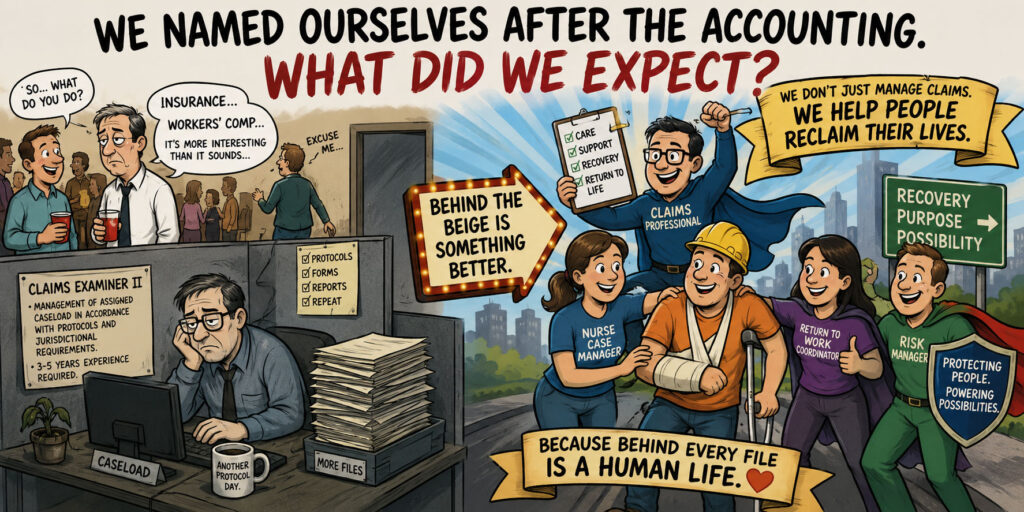
There is a moment at every social gathering that those of us in this industry have learned to dread.
Someone asks what you do.
Now, regarding that question I normally provide the answer that is my stock in trade: As little as possible. But then you have to get serious. You have to say it.
And you watch yourself do the thing. You start with “insurance,” which is already a concession, because you can see the light behind their eyes begin its slow dimming. Then you add “workers’ compensation,” and they nod the way people nod at a diagnosis. And then, because you cannot help yourself, you spend the next forty seconds explaining that it is more interesting than it sounds, which is a sentence that has never once in human history made anything sound more interesting.
Somewhere around second thirty they excuse themselves to check on something in the other room. There is nothing in the other room.
I have watched this happen at weddings, at neighborhood cookouts, and once, memorably, at a funeral, which I want to be clear was not my fault.
We are, by a considerable margin, the worst storytellers in the American economy. And I have come to believe that this is not a public relations problem or an image problem. It is our single largest workforce problem, and it is entirely self-inflicted.
We named ourselves after the accounting.
Take a moment with that. Of all the things happening in this system, of all the possible descriptions available to us, we chose the one that describes the money moving. Firefighters did not name their profession “Municipal Combustion Response Funding.” Paramedics did not go with “Emergency Transport Cost Allocation.” We looked at an industry whose entire purpose is putting broken people back together and we called it compensation, which is a word from a ledger.
Then we built everything else on that foundation, and we did it with commitment. Our job titles are Claims Examiner and Adjuster, both of which describe filing. Our trade press headlines are about rate filings and combined ratios. Our conference names sound like tax seminars. Our industry’s dominant aesthetic is beige, and I say that as a man who has personally spoken in more beige ballrooms than I can count.
And then there are the job postings. I want to share a specimen, lightly composited from several real ones, because it demonstrates the problem in a form so pure it belongs in a museum:
Claims Examiner II. Responsible for management of assigned caseload in accordance with established protocols and jurisdictional requirements. Requires 3 to 5 years experience.
There is not one human being in that paragraph. Not one. There is a caseload, there are protocols, there are jurisdictional requirements, and there is a person who is apparently supposed to already have three years of experience doing a job that no employer will let them start without three years of experience. We have constructed a profession that can only be entered by people who are already in it, and then we hold panels asking why nobody new shows up.
The answer is that we have hidden the door, and also we did not tell anyone there was a building. And god forbid we should tell them the building is both noble and cool.
Here is what we do instead of recruiting.
We hire each other. An adjuster leaves a carrier for a TPA, a TPA person goes to a broker, a broker’s risk manager moves to a self-insured employer, and everyone congratulates everyone on LinkedIn about their exciting new chapter. Somebody’s headcount problem is solved and somebody else’s headcount problem is created, and the total number of people in workers’ compensation goes down by one every time a person retires.
We are not building a talent pipeline. We are passing the same people back and forth and calling the motion growth. It is musical chairs, except we remove a chair every time someone turns sixty-five, and nobody is adding new players to the game.
And I want to be fair here, because there are real efforts underway. There are risk management degree programs. There are apprenticeship pilots. There are companies doing genuinely thoughtful work on early-career development, and they know who they are because I have been loudly complimenting them for years. Mine is one of them, which you may consider disclosed. But the honest scale of it is a handful of programs against an industry of hundreds of thousands, and hope is not a workforce strategy.
Everything above is the joke. Here is the thing underneath it, and I am going to drop the routine for a few paragraphs.
The people outside this industry believe we manage files and litigate claims. That is genuinely what they think we do. They think we are the people on the other end of the phone who say no, and the reason they think that is that we have never once made a serious effort to tell them otherwise.
But when this system works, and it does work, far more often than our critics admit and far less often than we should accept, here is what actually happens.
A man falls off a roof on a Thursday morning. In the space of about four seconds, everything he had is gone. His income, his ability to pick up his daughter, his sense of himself as the person in his family who handles things rather than the person who needs handling. That is a shattered life. Not a claim. A shattered life, with a file number stapled to it.
And then a system built for exactly this moment picks him up. It pays his mortgage while he cannot work. It buys him a surgeon and a physical therapist and a case manager who calls to check on him. It fights with his employer about modified duty and wins. And eighteen months later he is back on a roof, or he is doing something else entirely because we paid to retrain him, and he is whole. Not the same. Whole.
We did that. That is the actual product. Somebody gets their life back, and a family that was headed for the financial cliff does not go over it.
Multiply that by every workplace injury in America and you get the second thing we never talk about, which is that this system is load-bearing for the entire employment economy. Employers can operate because their catastrophic exposure is predictable. Workers can take physically demanding jobs because the floor beneath them is real. That bargain is the reason a construction economy exists in a country where a single injury could otherwise bankrupt both the worker and the company he works for.
And it was first. Before Social Security, before unemployment insurance, before Medicare, this was America’s original social insurance program. We invented the idea that a country takes care of the people its economy breaks. We were the prototype for all of it.
Nobody knows that. Not one person under thirty knows that, and the fault is not theirs.
We just suck at selling ourselves.
So here is my modest proposal, and it does not require anyone to change a statute.
Stop recruiting for the job and start recruiting for the purpose. There is a generation entering the workforce that is famously, sometimes exhaustingly, insistent on doing work that means something. We have spent fifteen years complaining about that generation at conferences. They are not the problem. They are the single best-matched labor pool our industry has ever been handed, and we are advertising to them with the phrase “management of assigned caseload in accordance with established protocols.”
We are sitting on one of the great untold stories in American working life and we have chosen, apparently as a group, to describe it in the language of a bank statement.
I have argued for years that we should call this Workers’ Recovery, and people tend to treat that as a branding preference, a bit of harmless Cluttered Desk eccentricity. It is not. The word you use to describe your work determines who wants to do it. Compensation attracts people who are comfortable processing transactions. Recovery attracts people who want to fix something. We have been running the wrong advertisement for a hundred years and then acting surprised at who answered it.
The next time someone at a party asks what you do, try this instead. Tell them you put people’s lives back together after their worst day.
Then watch what happens. Nobody has ever walked away from that sentence to go check on something in the other room.